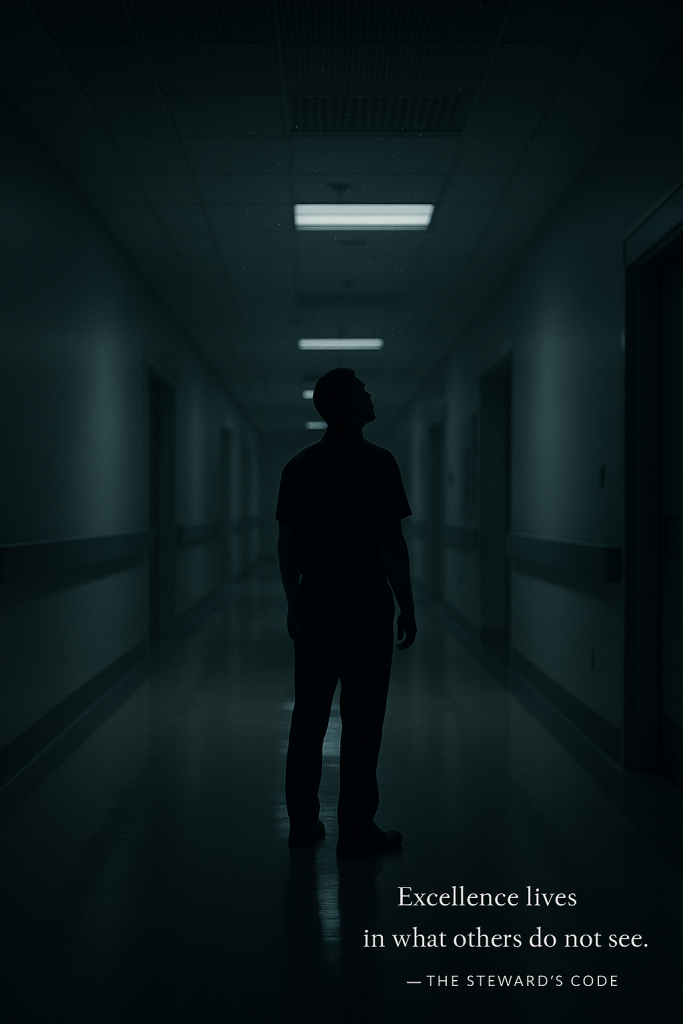
I haven’t even been on the job 30 days.
I’m still learning the operation, the people, the cadence.
But for the first time in months, I didn’t sleep.
Not from stress.
But from clarity.
Something small had made itself impossible to ignore.
Dust.
When Something Small Stops Being Small
Dust doesn’t demand attention.
It waits.
It settles where people stop looking — high ledges, vents, light fixtures, places marked mentally as later. It doesn’t arrive dramatically. It accumulates quietly, patiently, until it becomes normal.
That’s what unsettled me.
Because dust is rarely just about cleanliness.
It’s about awareness.
What Dust Tells You If You’re Paying Attention
In high-risk environments, dust tells a story long before problems appear.
It shows where standards have softened.
Where routines became habits.
Where accountability blurred to avoid discomfort.
Dust moves. It circulates. It reenters the air every time a door opens, a bed rolls, or a system breathes. What seems settled is often just suspended.
That’s not speculation.
That’s reality.
“It Looks Fine” Is Where Risk Begins
There’s a dangerous comfort in surfaces.
It looks clean.
It’s probably okay.
No one’s complained.
Those phrases aren’t neutral. They’re signals.
Looking clean is not the same as being safe.
Looking finished is not the same as being complete.
Excellence doesn’t rely on what’s obvious.
It depends on what’s controlled.
Why This Hit Me So Early
When you’re new, the natural instinct is to observe. To give yourself time. To ease into authority.
But responsibility doesn’t wait for onboarding to finish.
That night, what kept rising wasn’t anxiety — it was understanding. The realization that once you see clearly, you inherit accountability. Not later. Not gradually. Immediately.
You don’t get to unsee what matters.
The Quiet Failure No One Notices
No alarms go off when a detail is skipped.
There’s no immediate consequence.
And that’s why it’s dangerous.
When something feels invisible, it gets repeated.
When it gets repeated, it becomes culture.
Culture doesn’t shift because of one big mistake.
It erodes through tolerated small ones.
Where I Draw the Line
I believe standards are a form of respect — for people you may never meet but are responsible for protecting.
High-level care is built in places no one applauds.
On surfaces no one points to.
In tasks people assume aren’t urgent.
High dusting isn’t negotiable to me.
Not because of rules — but because prevention is silent, and silence is deceptive.
The Climb Changes Your Vision
As you climb, your eyes sharpen.
You stop overlooking what others normalize.
You start noticing what doesn’t announce itself.
You understand that leadership lives where comfort ends.
That’s the weight of the climb.
Not authority.
Not titles.
Responsibility.
Final Thought
Dust is not just dirt.
It’s a reminder that excellence lives in the details we choose not to ignore — and leadership means caring anyway.
Even when it’s quiet.
Especially when it’s quiet.
 The Climb
Leave a comment